

TLS + bearer auth
Every connection is encrypted and authenticated. The gRPC boundary speaks the muxr.v1 protobuf contract over TLS with bearer-token auth; a self-signed server's certificate is pinned at pairing.
Attach to your remote zellij and herdr sessions from your iPhone, iPad or Android device.
Muxr attaches to your zellij and herdr sessions, with full session, tab and pane control and touch-native gestures. That includes the sessions where your coding agents (Claude Code, Codex and others) run, so you can watch and steer them from your phone.
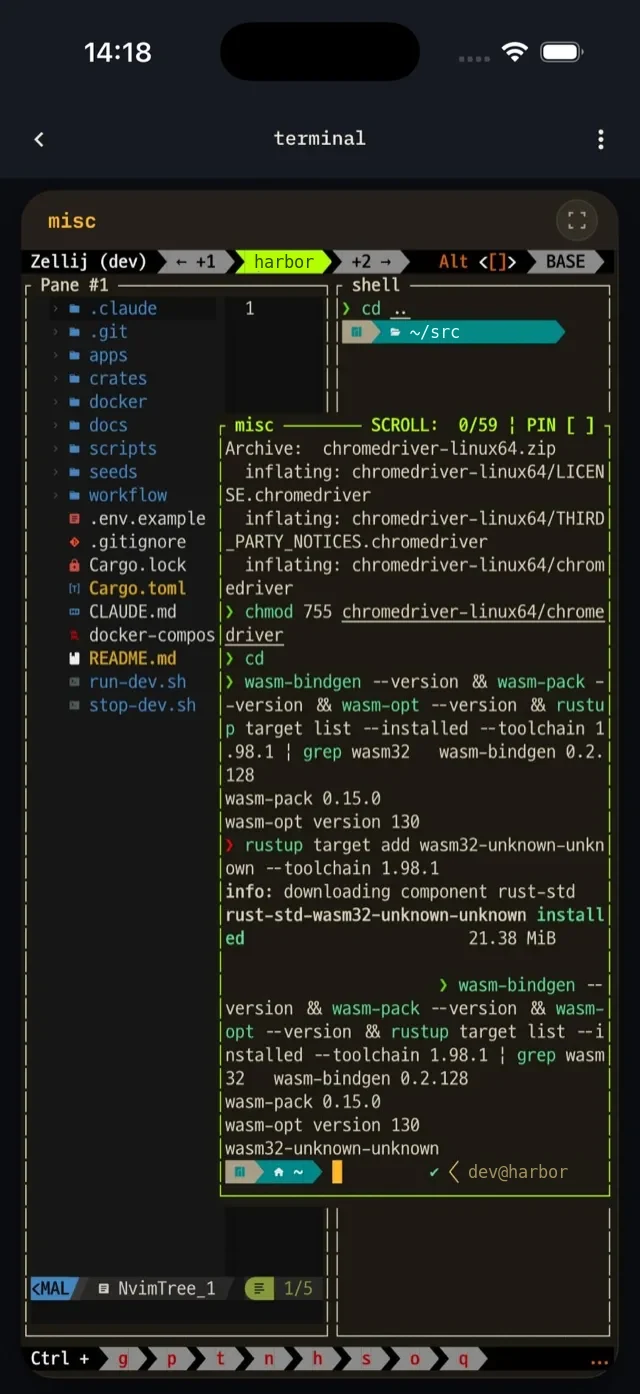
Everything you need to drive a herdr or zellij server from a touch device, secured and self-hosted. The server and the app are source available under PolyForm Shield 1.0.0.
Every connection is encrypted and authenticated. The gRPC boundary speaks the muxr.v1 protobuf contract over TLS with bearer-token auth; a self-signed server's certificate is pinned at pairing.
Pair from the setup TUI by scanning a QR. For a self-signed server the code pins the certificate fingerprint; for a CA-signed server the app uses system trust.
Create, rename, and close sessions, tabs, and panes — or switch spaces on herdr. Drive the whole multiplexer, not just a single attached pane.
Tap to focus, tap again for the keyboard, double-tap a pane to toggle its fullscreen, long-press text to select it, swipe back to peel immersive layers. A modifier key bar covers Ctrl, Alt, Esc, arrows.
On tablets a persistent 220 px pane rail lists tabs and panes alongside the terminal — collapsing to a 56 px icon mini-rail in immersive mode.
Mint per-device tokens, read-only or read-write — mutating RPCs fail closed on read-only. Saved credentials are gated behind a biometric unlock for one-tap reconnect.
Yes. Run your coding agent, such as Claude Code or Codex, inside zellij or herdr on your own machine, then attach to that session from Muxr and see its real terminal.
On herdr, an agents list shows which agents are blocked, done, working or idle, most urgent first. On zellij the agent appears as a terminal like any other pane, because zellij reports no agents. Muxr does not integrate with any specific agent: it shows the terminal the agent runs in. Push notifications are coming soon.
How to use Claude Code and Codex from your phone · Muxr and Claude Code Remote Control compared
Self-host the source available backend, pair once, and you are driving herdr or zellij from anywhere on your network.
muxrd next to your herdr or zellij install — it auto-detects whichever is present. It binds 127.0.0.1:50051 by default — put the machine on your tailnet and bind its Tailscale address in the setup wizard.muxrctl setup wizard, mint a token, and scan the QR it shows. The code encodes the host, port and token; for a self-signed server it also pins the certificate fingerprint, and for a CA-signed server it uses system trust — no further prompts.Moshi is a capable SSH terminal for phones. Muxr takes a different route: a source available daemon on your server and a one-time price. This is the short version; the full page has sources for every cell.
| Muxr | Moshi | |
|---|---|---|
| Price model | Free app with one server. Muxr Pro is a one-time $19.99 purchase, 50% off ($9.99) until January 13, 2027. Pricing | Free tier, then Pro. Website: Pro $9.99 per month, $89.99 per year, Lifetime $199 once (Moshi pricing page). App Store: Pro Monthly listed at $6.99, $7.99 and $9.99; Pro Yearly at $69.99 and $89.99; Pro Lifetime $249.00 (Moshi App Store listing). |
| Subscription | None | Monthly and yearly plans, or a lifetime price (prices in the row above). |
| Connection | muxrd, a daemon on your own machine; gRPC over TLS with a per-device token. No SSH between app and server. Pairing by QR code. | SSH, Mosh or Eternal Terminal straight to your host, with no relay (getmoshi.app). |
| Server install | Required: you install muxrd next to zellij or herdr. | None required; an optional hook adds agent context. |
| zellij | Yes | Yes, with a session picker and shortcut panel. |
| herdr | Yes, the herdr 0.9.x server (0.9.0 to 0.9.5). herdr-core is not supported. | Yes, with a workspace picker and shortcut panel. |
| tmux | Coming soon | Yes |
| Push notifications | Coming soon | Yes, when agents need you. |
Moshi details are taken from getmoshi.app as published on 15 November 2026 and may have changed. Moshi is a trademark of its owner; Muxr is not affiliated with it.
Muxr is a mobile app for iPhone, iPad and Android phones and tablets that attaches to remote zellij and herdr terminal-multiplexer sessions. It talks to muxrd, a daemon you run on your own machine next to zellij or herdr. More about Muxr
tmux support is coming soon. It is not available today. See the roadmap.
Muxr is free to download, and the free app is the full app with one server. Muxr Pro is a one-time $19.99 purchase, 50% off ($9.99) until January 13, 2027. Pricing
No. Terminal traffic goes from the phone to your own server and does not pass through any server run by F0X IT LLC. Privacy
Muxr by F0X IT LLC (muxr.app) is a zellij and herdr client and is unrelated to the npm package @trymuxr/cli at trymuxr.com.
The server relays over your multiplexer's native IPC — zellij's Unix-domain sockets or herdr's wire protocol — so what you see on the phone is the real session state.